
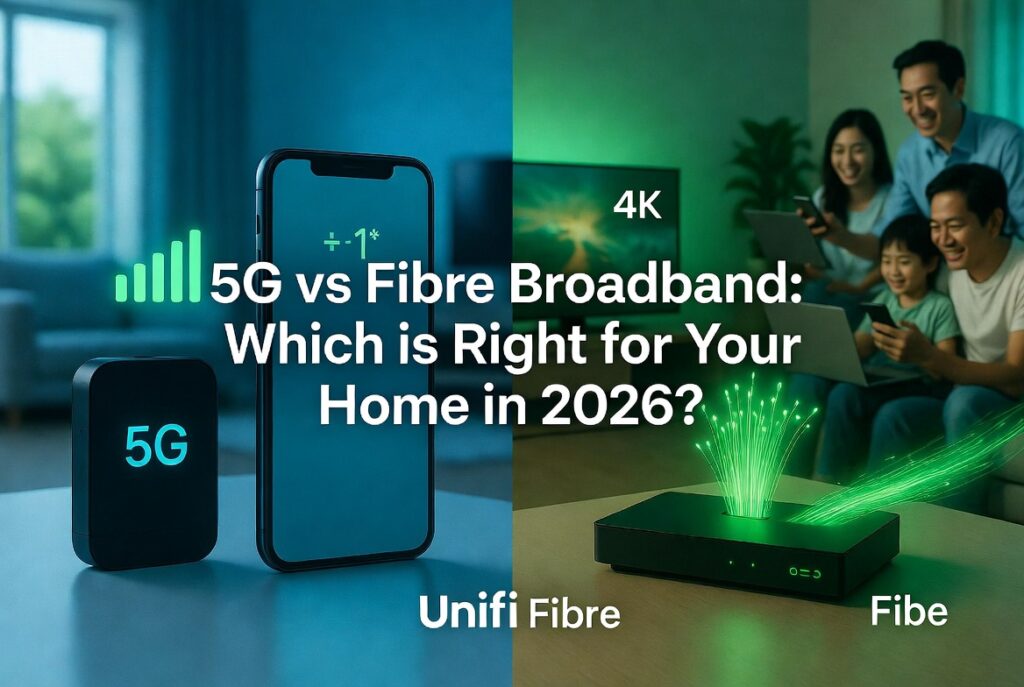
Home internet technology has evolved rapidly over the past few years, and in 2026, consumers now have more choices than ever before. Besides traditional fibre broadband services such as Unifi, many internet providers are aggressively promoting 5G home internet as a faster, simpler, and more flexible alternative.
Because of this, many homeowners are asking an important question:
Should you choose 5G home internet or traditional fibre broadband for your home in 2026?
At first glance, 5G internet sounds extremely attractive. Providers advertise fast installation, wireless convenience, and impressive download speeds without requiring fibre cable installation. For some households, 5G home broadband can indeed be a good solution.
However, fibre broadband still remains the gold standard for internet stability, consistency, and long-term reliability in many situations.
The best choice depends on several important factors, including:
- Your location
- Internet usage habits
- Household size
- Gaming and streaming needs
- Work-from-home requirements
- Budget considerations
- Coverage availability
In this article, we will compare 5G home internet and fibre broadband in detail, explain their real-world advantages and disadvantages, and help you determine which option is better for your home in 2026.
What Is Fibre Broadband?
Fibre broadband is a wired internet connection that uses fiber-optic cables to transmit data using light signals.
Unlike older copper-based internet technologies, fibre broadband offers significantly faster speeds, lower latency, and more stable performance.
Fibre internet has become the preferred option for many households because it provides consistent high-speed connectivity suitable for modern internet usage.
Today, fibre broadband is commonly used for activities such as:
- 4K and 8K streaming
- Online gaming
- Remote work
- Video conferencing
- Cloud backups
- Smart home systems
In Malaysia, popular fibre broadband providers include services such as Unifi, TIME, and Maxis Fibre.
Because fibre uses physical wired infrastructure, it generally delivers more stable and predictable performance compared to wireless internet technologies.
What Is 5G Home Internet?
5G home internet uses mobile network technology instead of physical fiber-optic cables.
Instead of connecting through underground fibre infrastructure, 5G home broadband receives internet wirelessly from nearby 5G mobile towers.
A 5G home setup usually includes:
- A 5G modem or router
- A SIM card
- Wireless connection to a nearby 5G tower
- WiFi distribution throughout the home
One major reason 5G home internet has become popular is convenience.
Unlike fibre broadband, 5G home internet often does not require:
- Fibre cable installation
- Technician appointments
- Wall drilling
- Complex setup procedures
For users living in areas without fibre coverage, 5G internet can provide a much faster alternative compared to older broadband technologies.
Speed Comparison: 5G vs Fibre Broadband
One of the biggest marketing points for 5G internet is speed.
Under ideal conditions, modern 5G networks can deliver extremely impressive download speeds that sometimes rival fibre broadband.
In some cases, 5G home internet may achieve speeds such as:
- 100 Mbps
- 300 Mbps
- 500 Mbps
- Even 1 Gbps under ideal conditions
However, real-world internet performance depends on much more than peak speed numbers alone.
Fibre broadband generally provides:
- More consistent speeds
- Better stability
- Lower fluctuations
- Reliable performance during peak hours
Meanwhile, 5G speeds may fluctuate depending on:
- Signal strength
- Tower congestion
- Weather conditions
- Distance from the tower
- Indoor interference
This means 5G speeds can vary significantly throughout the day.
For lighter internet users, this may not be a major issue. However, for heavy users, consistency often matters more than maximum peak speed.
Stability and Reliability
Internet stability is one of the biggest differences between fibre broadband and 5G internet.
Because fibre broadband uses physical cable connections, it is generally much more stable and predictable.
Fibre internet is less affected by external environmental conditions such as:
- Weather
- Signal interference
- Network congestion
- Physical obstacles
This creates a more reliable experience for activities requiring stable connections.
Stable internet becomes especially important for:
- Video conferencing
- Online gaming
- Remote work
- Livestreaming
- Smart home systems
5G internet, on the other hand, depends heavily on wireless signal quality.
Wireless signals may weaken because of:
- Thick walls
- Building structures
- Tower congestion
- Signal obstruction
- Distance from the tower
As a result, 5G internet performance may fluctuate more frequently compared to fibre broadband.
Latency: Why Gamers Usually Prefer Fibre
Latency, also known as ping, measures how quickly data travels between devices and servers.
Lower latency creates faster responsiveness during real-time online activities.
This becomes important for activities such as:
- Competitive gaming
- Video conferencing
- Remote desktop work
- Cloud gaming
Fibre broadband generally delivers lower and more stable latency compared to 5G internet.
Because fibre uses direct wired infrastructure, data transmission is usually more consistent and predictable.
5G latency has improved significantly compared to older mobile networks, but wireless conditions can still create fluctuations.
For casual browsing or streaming, users may not notice much difference.
However, competitive gamers and heavy remote workers often prefer fibre broadband because of its lower and more stable latency performance.
Installation and Setup Convenience
One area where 5G home internet has a major advantage is installation simplicity.
Fibre broadband installation often requires:
- Technician appointments
- Fibre cable installation
- Wall drilling
- Equipment setup
- Waiting periods
Depending on the building and location, installation may sometimes take days or even weeks.
5G home internet is usually much simpler.
Most 5G setups only require:
- Plugging in the router
- Inserting the SIM card
- Connecting devices to WiFi
This makes 5G especially attractive for renters or users who want fast internet setup without installation delays.
For temporary living arrangements, 5G can provide much greater flexibility.
Coverage Availability Matters
Availability remains one of the biggest deciding factors between fibre and 5G.
In some areas, fibre infrastructure may still be unavailable or limited.
This commonly affects:
- Rural areas
- Older buildings
- New developments
- Remote housing locations
In these situations, 5G home internet may become the better option simply because it is accessible.
However, 5G coverage quality itself also varies heavily depending on location.
Strong 5G performance usually depends on:
- Nearby tower availability
- Signal strength
- Indoor reception quality
- Network congestion levels
Before choosing 5G internet, users should first verify whether strong and stable 5G coverage exists inside their home.
Data Limits and Fair Usage Policies
Another important factor users should evaluate carefully is data policy.
Most fibre broadband plans today offer:
- Unlimited data usage
- Stable long-term performance
- No major speed throttling
Some 5G home internet plans, however, may still include:
- Fair usage policies (FUP)
- Speed throttling
- Network prioritization during congestion
Heavy internet users should carefully review plan details before subscribing.
This becomes especially important for households that regularly:
- Stream 4K videos
- Download large files
- Play online games
- Use cloud storage heavily
In many situations, fibre broadband still provides more reliable unlimited usage for large households.
Which Is Better for Smart Homes?
Modern homes now connect many internet-enabled devices simultaneously.
This includes not only phones and laptops, but also smart home systems operating continuously in the background.
Smart homes commonly use devices such as:
- CCTV cameras
- Smart TVs
- Smart lighting
- Smart locks
- Voice assistants
- Smart appliances
Stable internet becomes extremely important when many devices communicate simultaneously.
Fibre broadband usually handles these environments more consistently because of its stable wired infrastructure.
5G internet can still perform well for smart homes, but heavy congestion or signal fluctuations may occasionally affect stability.
For larger smart home ecosystems, fibre often remains the safer long-term option.
Cost Comparison: 5G vs Fibre Broadband
Pricing varies depending on providers and promotions, but both technologies now compete aggressively in 2026.
5G home internet may sometimes offer advantages such as:
- Lower installation costs
- Faster activation
- No wiring fees
- Flexible contracts
Meanwhile, fibre broadband often provides:
- Better long-term value
- More stable performance
- Better unlimited usage support
- Higher consistency
For many households, the decision ultimately depends on whether convenience or stability matters more.
Who Should Choose 5G Home Internet?
5G home internet can be an excellent option for certain types of users.
It is especially suitable for people who prioritize flexibility and quick setup.
5G internet may work well for users who:
- Live in fibre-unavailable areas
- Rent temporary properties
- Need fast installation
- Move frequently
- Have lighter internet usage
In areas with strong 5G coverage, users may experience very good performance without requiring fibre installation.
Who Should Choose Fibre Broadband?
Fibre broadband remains the best choice for users who prioritize stability, consistency, and long-term performance.
This becomes especially important for households with many active users and devices.
Fibre broadband is usually ideal for:
- Gamers
- Remote workers
- Large families
- Smart home users
- Heavy streamers
- Content creators
For users requiring highly stable and predictable internet, fibre still remains the strongest option in 2026.
Final Thoughts
Both 5G home internet and fibre broadband offer strong advantages in 2026, but the right choice depends heavily on your lifestyle, location, and internet needs.
5G internet provides excellent flexibility, fast setup, and improving performance, especially in areas without fibre infrastructure.
However, fibre broadband still remains the superior option for users who prioritize stable speeds, lower latency, and long-term reliability.
For many Unifi users and modern households, fibre broadband continues to provide the best overall home internet experience for gaming, streaming, remote work, and smart home usage.
Before choosing between 5G and fibre broadband, it is important to evaluate your actual usage needs instead of focusing only on advertised speed numbers.